Article
The Manager Blueprint: Where Strategy Execution Breaks and How to Fix It
The Manager Blueprint: Where Strategy Execution Breaks and How to Fix It
The Manager Blueprint: Where Strategy Execution Breaks and How to Fix It
The Manager Blueprint: Where Strategy Execution Breaks and How to Fix It

Blogs on people, performance & growth
Blogs on people, performance & growth
Blogs on people, performance & growth
Blogs on people, performance & growth

Andrew Heath
Andrew Heath
Nine out of ten executives don't think performance management creates value in their business. That stat, from Deloitte, sums up the problem I opened our latest webinar with. Performance management has an identity crisis, a delivery problem, and the wrong name.
In the session I walked through a blueprint you can hand a manager this afternoon and watch it lift the way they work with their team. This post pulls together the core of it. You can watch the full recording here:
Watch the webinar: The Manager Blueprint
If you want the groundwork first, the previous session covers how to cascade strategy so it actually lands with people: watch session one.
The gap opens at the manager layer
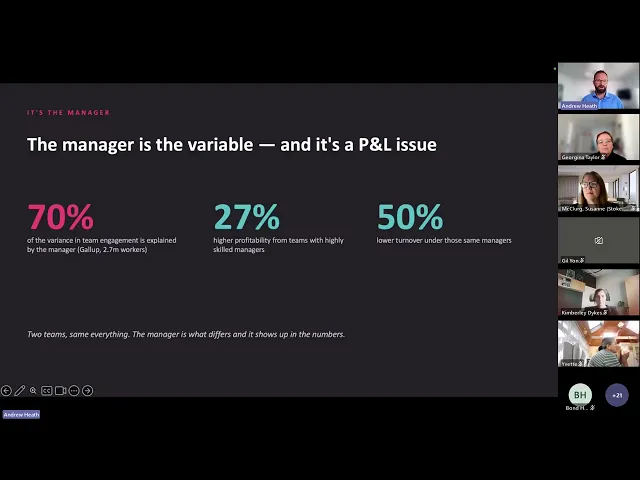
Picture two teams doing similar work. One is over target, people are happy, no one is leaving. The other tanks: constant problems, people on improvement plans, a bad vibe all round. The difference between them is the person running the team.
We often point the finger at the manager. Sometimes that's fair. More often the infrastructure around them gives no support: the way they're asked to manage their teams adds no value and isn't clear or easy to use.
When we surveyed the market, inconsistent manager quality was a core reason strategy failed to land for half the businesses we spoke to. And it's the middle managers where the problem shows up. If you take the shape of an organisation as a pyramid, the bulk of the headcount sits in the layer with the least clarity on the strategy. Our research found 53% of people don't know how their daily work helps the business hit its strategy. Multiply your salary bill by that number and you can see the cash you burn.
So job one is clarity: managers need to know what the strategy looks like at their level. Job two is getting them to drive it on an ongoing basis. That's what the blueprint does.
Rename the thing
Nobody wants to be performance managed. The phrase implies you're not performing if you need the conversation. A better frame is strategy alignment.
If you've hired someone with the right skills and shared values, and they're clear on what you're trying to do, the default should be that they can deliver. Most of the time the issue is a gap between the strategy and how it relates to their work. You can get a performance problem if that gap widens too far. But the conversation should start from: this is what we need to do, this is your piece, how close are we?
When managers don't have these conversations, HR tends to respond by stripping the process back - one meeting a year, fewer questions. That lowers the value, so people engage even less. The fix is the reverse. Make the process create value for all three people who touch it:
The organisation gets people who understand the strategy and work towards it.
The manager sees their team perform better. This is the only reason they'll keep doing it. Not because HR is on their back or there's a box to tick in the software.
The employee finally understands why they're doing the work and how to bring their skills to bear.
Three cornerstones: cadence, focus, quality
Cadence. The sheep-dip approach doesn't work. Every part of your business runs to a different tempo. Tell an engineer shipping sprints every seven days that you'll check in quarterly and it falls apart. Let the team leader set the cadence for their team, then dovetail the conversations with how the work actually moves.
Focus. Keep the golden thread visible: what am I doing this week that relates to my goal, the team's objective, and the company strategy? This matters most when the strategy changes. I spoke to someone whose business had pivoted, and two months later a junior team member was still executing the old plan. That's two months of effort pointed the wrong way, and it's not rare.
Quality. This isn't rocket science and your managers don't need a long course. It's asking slightly better questions. Stop, start, continue works every time: what should we stop doing that wastes time, what should we start that would help, what's working that we should keep. Come at it with curiosity rather than as an interrogation and you get a far better conversation.
The one-card rhythm
The blueprint is a short document a manager can run in minutes. People want the lowest effort for the highest reward, so step one is to cut the friction and raise the value.
The rhythm runs like this:
Golden thread. Company strategy, team strategy, the objective and key result, and what the individual is working to achieve. Everyone gets an accountability number.
On track or off track. If you're on track, ask whether you could go faster - raise the target, serve more clients, automate a step. If you're off track, the employee turns up with the plan to get back on track. Nine times out of ten they know the answer, so empower them to bring it.
Capability check. This is where managers should spend their time. What's blocking this person - missing training, wrong kit, a bad brief - that I can clear out of the way?
Think for themselves. Ask what they'd do differently and how they'd help. That builds a team with agency, where managing gets easier over time.
Done at a cadence that fits the team, the process starts to self-correct. People spot the drift before the next check-in and come to you with a fix.
Where the manual version runs out
The PDF works and it'll beat most of what you're doing today. It also has a limit: it's manual. That's why we built RoleKick. The platform gives everyone clarity on what they're doing against the company objectives, pulls anything off track onto the agenda automatically, and has a note taker capture the 1:1 so the write-up and the next set of goals happen on their own. It doesn't replace the manager. The relationship between a manager and their employee governs all of this. The platform just takes the grief off the table so the manager can focus on the people.
What people said on the day
"Awesome session, exactly what was needed." - Helena V
"Very good session, Andy. Excellent and simple explanation, with clear steps." - Stephen W
Try it on your own business
If this resonates and you'd like to look at your own setup, book a strategy audit with me. It's 30 to 40 minutes, no sales, about 20 questions about your organisation, and you leave with a report of your gaps and opportunities.
Give managers simple rules of engagement and they do a better job. Watch the full webinar, catch session one on cascading strategy, and come have a chat.
—
Ready to see it
Strategy execution for high-growth teams, in your inbox
Strategy execution for high-growth teams, in your inbox
Practical writing on people, performance and delivering strategy.
—
FAQs
FAQs
FAQs
Clarity on what RoleKick does, how it fits, and why it works.
Clarity on what RoleKick does, how it fits, and why it works.
Get the visibility your HR platforms don't give you
Get the visibility your HR platforms don't give you
Get the visibility your HR platforms don't give you
Get the visibility your HR platforms don't give you
See your strategy cascade into goals — and exactly where execution is on track or at risk.
See your strategy cascade into goals — and exactly where execution is on track or at risk.
For companies with 50–500 employees. No obligation.

The execution layer that connects your strategy to every goal, every team and every person.
© 2026 RoleKick. All rights reserved.
The execution layer that connects your strategy to every goal, every team and every person.
© 2026 RoleKick. All rights reserved.
The execution layer that connects your strategy to every goal, every team and every person.
© 2026 RoleKick. All rights reserved.
The execution layer that connects your strategy to every goal, every team and every person.
© 2026 RoleKick. All rights reserved.